

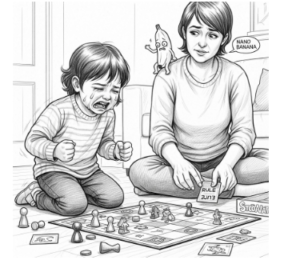
Raise your hand if you’ve ever watched a child cry over a lost board game and immediately felt the urge to explain why the game was unfair, suggest a rematch, or quietly change the rules so they’d win. (Don’t worry. We’ve all been there. We will find a way to navigate through this chaos.
Here’s the thing: we live in a moment where a generation of parents—many of whom grew up hearing “life is hard, deal with it” before the sentence was even finished—has decided that their children will not feel that kind of pain. Not on their watch. A tuition center, a retest, a carefully worded conversation with the class teacher, or a participation trophy cannot ensure it.
The question worth asking is, what happens to a generation raised inside that decision?
First, Let’s Agree on What “Handling Failure” Actually Means
Before anyone gets defensive—and people will get defensive—let’s be precise about what we’re discussing. Handling failure doesn’t mean being told you deserved to lose and to stop crying about it. It doesn’t mean toughening children up through cruelty or indifference.
It means this: the ability to experience a setback, sit with the discomfort of it, and find a way forward without that discomfort becoming paralyzing.
Think of it like the immune system. A child who is never exposed to any germs doesn’t develop immunity. A child who is protected from every disappointment doesn’t develop the emotional antibodies to handle the inevitable ones later. The goal was never to make childhood painful. The goal is to make adulthood survivable.
Pause and let that sink in.
We are not debating whether children should suffer. We are debating whether protecting them from all difficulty is, paradoxically, the very thing that makes them fragile.
Something Has Shifted. The Evidence Is Hard to Ignore.
Every older generation has accused the younger one of being soft. That’s not new. But this time, the data is showing up in clinical settings, not just in uncle’s opinions at family dinners.
Rates of anxiety and depression among young people in India have risen sharply in the post-pandemic period. A 2023 UNICEF report indicated that approximately 14% of Indian adolescents experience mental health challenges—a figure widely considered an undercount given stigma and under-reporting (illustrative; UNICEF India, 2023). Counsellors at schools and colleges report growing numbers of students who struggle significantly with academic setbacks, social conflict, and any form of public criticism or evaluation.
In the US and UK—where this research is further developed—college campuses have documented a marked increase in students seeking counselling after receiving a poor grade, being rejected from clubs, or losing elections to student body positions. These are not unusual events. They are, in fact, the ordinary furniture of growing up.
None of this is the fault of young people. They didn’t design the environment they grew up in. We did.
The India Edition: Where Failure Is Both Catastrophised and Hidden

India’s relationship with failure is particularly complex, operating simultaneously in two opposing directions.
On one side, we catastrophize failure with extraordinary efficiency. The Class 10 board result is treated not as an academic milestone but as a referendum on a child’s entire future, their family’s reputation, and their grandmother’s blood pressure. The pressure around IIT-JEE, NEET, and CA exams is so intense that it has generated a genuine mental health crisis in cities like Kota, where coaching institutions house teenagers who are being optimized for a single test at the expense of almost everything else.
In Kota, children’s preparation for a single exam is the primary industry. Pause and let that sink in.)
On the other side—and this is the less discussed part—we hide failure with equal efficiency. The child who didn’t make the school cricket team was “uninterested anyway.” The daughter who failed her driving test “hasn’t really started trying yet.” The son who lost the debate competition was “up against judges who didn’t understand his points.” The reframing happens so fast, so automatically, and with such loving intention that the child barely has time to process what actually happened.
The result is a generation that has learned two things simultaneously: failure is catastrophic, and it never actually happened.
That is not a foundation for resilience. That is a setup for a catastrophic collision with reality.
The WhatsApp Parent Group: A Case Study in Collective Anxiety
No examination of modern Indian parenting is complete without addressing the family and parent WhatsApp group—which has evolved from a place to share festival wishes into something that functions like a real-time anxiety broadcasting network.
Shreya is a 38-year-old marketing professional in Mumbai and mother of a 13-year-old. Her son’s school has four parent WhatsApp groups—one per subject. “The night before a unit test,” she says, “the groups go into full crisis mode. Parents are sharing notes at midnight, asking if anyone has the teacher’s ‘important questions,’ and sending their children last-minute summaries. My son looked at me once and said, ‘Amma, why are you more stressed than me?'” She didn’t have a satisfactory answer.

This is the texture of the problem. It’s not malicious. It is, in fact, love—unprocessed and misdirected. The parent who cannot tolerate their child’s distress ends up absorbing it, managing it, and fixing it. And the child learns, quietly, that distress is something that gets rescued from rather than moved through.
The Social Media Accelerator
Here’s a dimension of this problem that didn’t exist for any previous generation: failure is now potentially permanent and public.
A teenager who fumbles a presentation, makes a social mistake, or has a bad day can have that moment photographed, captioned, and shared before the school bell rings. The natural mercy of forgotten embarrassments—which previous generations relied on to develop social confidence—no longer operates cleanly.
The internet alters the consequences of failure in a manner that adults often underestimate. When we say, “just try; it doesn’t matter if you fail,” we are speaking from a world where failure had private consequences. Many young people today are navigating a world where failure can have an audience.
The response to that reality cannot be permanent protection from trying. It has to be about building the capacity to try publicly, fail occasionally, and keep going anyway. That capacity gets built through practice. It does not arrive fully formed.
What We’re Actually Getting Wrong
Rahul is a high school counselor in Bangalore who has worked with students for 11
years. “The pattern I see most often,” he says, “is not students who’ve experienced too much failure. Those who have never failed see their first setback as proof they are broken. They perceive themselves as failures, not just as having failed a test.
That distinction matters enormously.
A child who has experienced loss, made mistakes, faced embarrassment, tried again, and emerged triumphant has a point of reference. They know what recovery feels like from the inside. A child who has been kept from that experience has no such reference point. When difficulty arrives—and it always arrives—they are encountering it without the emotional vocabulary to process it.
The goal of raising resilient children is not to expose them to unnecessary hardship. The goal is to allow the common challenges of childhood, such as a lost game, a failed test, a friendship that didn’t work out, or a disastrous audition, to unfold naturally without adult intervention to shield them from the emotions.
The Tricky Part: Indian Academic Pressure Cuts Both Ways

In the Indian context, this conversation becomes genuinely complex, and it requires a straightforward approach.
Some of what gets called “fragility” in young Indians is actually a rational response to an irrational system. When a 0.5% difference in board exam marks determines which college you attend, which city you live in, and which marriage proposals come your way—students aren’t being oversensitive by treating that exam as high-stakes. It is high-stakes.
The problem isn’t that students take their results seriously. The problem is that we have built systems where a single test is allowed to carry this much existential weight, and then we tell students to be resilient about the outcome. That is asking individuals to develop psychological fortitude to compensate for structural dysfunction—which is unfair and only partially effective.
Real resilience-building and education reform are not competing projects. They are both necessary.
What Actually Builds Resilience (It’s Not What Most People Think)
Resilience is not built through motivational posters, stories about people who overcame adversity, or being told that failure is a stepping stone. These things are fine. They’re just not the mechanism.
Resilience is built through micro-experiences of recovery—small moments where something went wrong, the child felt awful about it, and then found their way through. Accumulated over years, these experiences form a genuine internal belief: “I have been here before. I got through it. I can do that again.”
Anjali is a product designer in Hyderabad and mother of two children, aged 9 and 12. Her approach is deliberate. “When my older one doesn’t get selected for something—a team, a role in the school play—I don’t immediately comfort or explain. I give it a day. Then I ask her what she thinks happened and what she’d do differently. Sometimes the answer is ‘nothing, it was unfair.’ And sometimes she figures out the actual thing. Either way, she owns the process.” Her daughter has, at various points, failed an audition, been dropped from a sports squad, and received a genuinely bad project grade. She remains, by her mother’s account, one of the more confident twelve-year-olds in her class. (Illustrative example.)
The model is simple. It’s just uncomfortable to execute.
Common Mistakes Parents and Educators Make

- Mistake 1: Rescuing too quickly. The child experiences disappointment. The adult immediately moves to comfort, explanation, or solution. The child never gets to sit with the feelings long enough to learn that they pass.
- Mistake 2: Reframing failure out of existence. “You didn’t really lose; you learned.” “The judges were biased.” “It doesn’t matter anyway.” These responses are well-intentioned and counterproductive. The child needed to lose. Explaining it away erases the experience.
- Mistake 3: Treating the child’s failure as the parent’s failure. When a child sees a parent visibly distressed by their setback, the child learns that their failure has consequences beyond themselves. They start managing the parent’s feelings instead of their own.
- Mistake 4: Confusing high expectations with high pressure. Expecting excellence is fine. Attaching love, worth, and safety to the achievement of excellence is the part that breaks people.
- Mistake 5: Teaching children to avoid risk rather than manage it. The safest child is one who never tries anything uncertain. That child is also learning that the world is too dangerous to engage with fully.
- Mistake 6: Talking about resilience instead of practicing it. No motivational talk ever built a child’s resilience. A lost football match and twenty-four hours to feel bad about it build resilience. Experience is the curriculum.
The Bottom Line
We are not raising a broken generation. We are raising a generation that has been protected—with enormous love and intention—from the very experiences that build the emotional infrastructure to handle an unprotected world.
The fix isn’t toughness. It isn’t withholding comfort or manufacturing hardship. It’s stepping back, just enough, to let ordinary difficulty do what it was always designed to do: teach children that they are more capable than the hard moment makes them feel.
Let the child lose the game. Let them feel it. Then, when they’re ready, ask them what they want to do next.
That is the whole curriculum.
Do you see this in the kids around you, or do you think we’re too hard on a generation facing tougher times? Drop your thoughts in the comments. And if this incident triggered a memory of a moment you wish you’d handled differently—as a parent, a teacher, or a child—I suspect you’re not alone.