
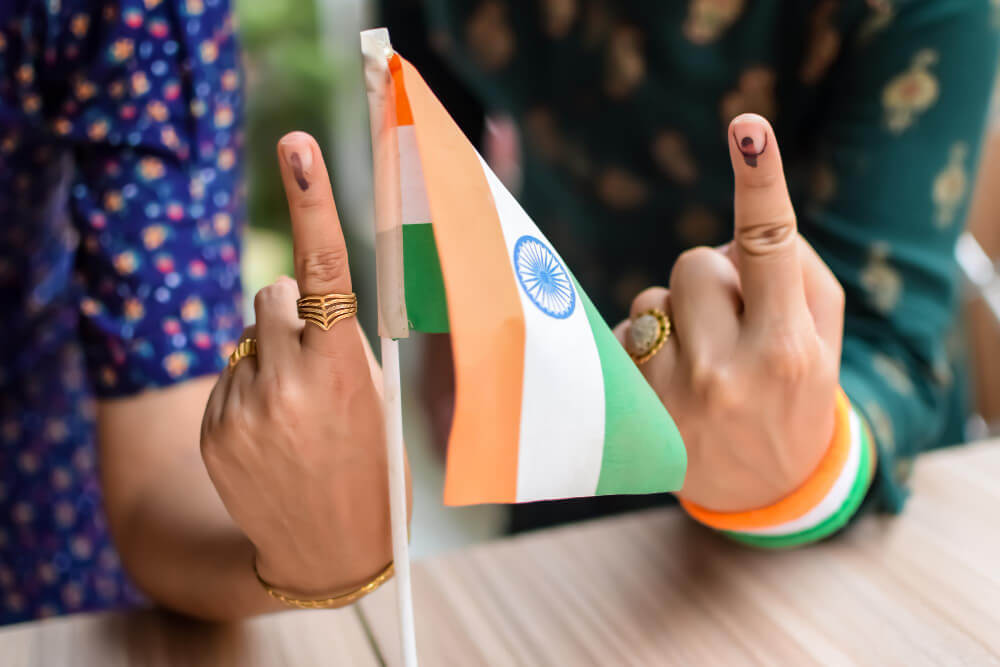
India is the largest democracy on the planet. Nearly a billion people are eligible to vote. And on a good election day, roughly a third of them simply don’t bother.
Let that number sit with you for a moment.
We built the world’s most ambitious democratic project—one that runs across 28 states, 8 union territories, 543 constituencies, and more logistical complexity than a Bollywood production gone over budget—and then a significant chunk of eligible voters look at it and go, “Nah, I’m good. “There’s a new season on Netflix.”
This episode is the context for one of India’s most recurring policy debates: Should voting be made mandatory?
Raise your hand if you’ve ever skipped voting because the queue was too long, you forgot your Voter ID, it was too hot outside, or you were vaguely planning to go but then lunch happened. (Don’t worry. We’ve all been there. We’re going to unravel the method behind this madness.
First, Let’s Agree on the Actual Problem
India’s national voter turnout hovers around 65-67% in general elections. On the surface, that sounds respectable. It’s not bad for a country with 969 million registered voters (as of the 2024 general election, the largest electorate in human history).
But look closer. That 65% figure means approximately 340 million eligible voters—more people than the entire population of the United States—did not cast a vote. These aren’t people without opinions. They hold opinions. Between nine o’clock in the evening and midnight, they are very vocal on news channels and in family WhatsApp groups about their ideas.
They just didn’t show up.
And here’s the uncomfortable truth that mandatory voting advocates lead with: governments get elected by the people who vote, not by the people who should have voted. When 35% of citizens opt out, politicians don’t have to care about them. Their policy priorities, their problems, their neighborhoods—all of it becomes optional.
Pause and let that sink in.
You didn’t vote. So nobody needed to win you over. So nobody came.
What Does “Mandatory Voting” Actually Mean?
Before the debate gets going, let’s be precise about what we’re actually discussing. The term “mandatory voting” often evokes images of government officials using clipboards to knock on doors, a practice that is not prevalent globally.
Mandatory voting—also called compulsory voting—means that eligible citizens are legally required to show up at a polling booth on election day. What they do once they get there is entirely up to them. Any candidate is up for election. One option is to choose “None of the Above” (NOTA). Their ballot can be spoiled.The state compels the act of showing up. It cannot compel the act of choosing.
Think of it like jury duty. The court requires your presence. Your verdict is your own.
Countries that practice compulsory voting include Australia, Belgium, Brazil, Singapore, and Luxembourg. Australia is the most famous case—voters who skip elections without a valid reason pay a fine of approximately AUD 20 (roughly ₹1,100). The result? Australia’s voter turnout consistently exceeds 90%.
India, interestingly, has already run this experiment at a smaller scale. Gujarat introduced mandatory voting for local body elections in 2015. Penalties for non-voting? A fine of ₹1. Not ₹1,000. One rupee. The policy was more symbolic than punitive—but the conversation it sparked was real.
The Case For: Why This Idea Has Genuine Merit
Before we begin to undermine the argument, let’s strengthen it.
Equality in the Voting Booth
Your vote is constitutionally equal to the Prime Minister’s vote. That is not a motivational poster. That is a structural fact of democracy. In the booth, a daily wage worker in Dharavi and a Tata Managing Director in Nariman Point have identical democratic weight. One vote each. The tools don’t care about your income tax bracket.
Pause and let that sink in.
Compulsory voting enforces this equality in practice, not just on paper.
Expanding the Political Incentive Structure
It forces politicians to court everyone, not just their vote bank. This is the most compelling argument for mandatory voting, yet it receives the least attention. When turnout is voluntary, politicians optimize for their guaranteed base. They do not need to earn the support of swing voters, young urban professionals, first-time voters, or migrant workers. What incentive is there to engage with those groups when they have historically not participated?
Implementing mandatory voting would significantly alter the electoral dynamics. Suddenly, every segment of society becomes a constituency that demands attention. Rural voters, urban voters, young voters, elderly voters—all of them matter now, because all of them will be in that booth.
Priya is a 28-year-old product manager from Hyderabad. She hasn’t voted in the last two state elections. “I kept meaning to,” she says. “But it always felt like my vote wouldn’t make a difference anyway. “The same people win every time.” (Illustrative example.) This is exactly the logic that mandatory voting disrupts. When 100% of the population participates, the guarantee of “the same people winning every time” ceases to exist. Priya’s vote—and the collective weight of millions like her—could change the outcome.
Read more about: Financial Independence at 40
Normalizing Civic Participation
It normalizes civic participation. Australia introduced compulsory voting in 1924. Within a generation, voting became a cultural habit, not a civic obligation. Today, Australians don’t debate whether to go. They go. The same normalization effect could work in India over time—but someone has to start the habit.
Infrastructure and Government Accountability
It would force investment in voting infrastructure. Right now, state governments can get away with inadequate booth facilities, long queues, and poor accessibility—because if non-voters stay home, that’s a problem they chose. Make voting compulsory, and the government is then legally obligated to ensure the process is actually workable. The government would be required to provide accessible booths, reasonable hours, and improved facilities. The law would force accountability in both directions.
The Case Against: Also Valid, and Significantly Funnier
Now let’s talk about the other side. In the Indian context, the argument against mandatory voting is not only based on principle, but it also provides a significant amount of entertainment value.
The Freedom Argument: The Right Not to Participate
Freedom includes the right not to participate. This is the cleanest philosophical objection. Liberty, in liberal democratic theory, includes negative liberty—the freedom to abstain. Forcing someone to engage in a political act, even symbolically, is a restriction of personal freedom. If I choose not to vote because I find all candidates equally unacceptable, that abstention is itself a political statement. Compelling me to enter a booth doesn’t change that—it just makes me press NOTA with mild irritation instead of staying home with mild irritation.
The Enforcement Problem: Who Exactly Are We Fining?
“Which 340 million people are we fining?” The logistics of enforcement in India are, to put it gently, ambitious. India has 969 million registered voters. Tracking who voted and who didn’t, sending notices, processing penalties, following up on appeals—for hundreds of millions of people, across every state, every panchayat, every municipal ward. The administrative machinery required doesn’t currently exist. Building it would cost more than the fine revenue it generates. This is not a hypothetical problem. It is a very real one.
The ₹1 problem. Gujarat’s experiment with compulsory local body voting set the penalty at one rupee. One. In most cities, the penalty is no longer even sufficient for a cup of tea. If the fine is trivial, the law is decorative. If the fine is meaningful—say, ₹500 or ₹1,000—it becomes regressive. A ₹500 fine hits a daily wage earner far harder than it hits a salaried professional. You’ve now created a system where the poorest citizens are most punished for non-participation. That is precisely backwards.
The “valid reason” problem can undermine the entire law. Every mandatory voting framework allows exemptions for illness, travel, religious grounds, or other valid reasons. In India—a country that has turned the medical certificate into an art form—the “valid reason” exemption would be claimed by approximately everyone. The certificate economy would simply expand to include election day.
Vikram, 34, a freelance consultant from Delhi, has a theory. “The day they announce mandatory voting,” he says, “every hospital in India will be at 200% capacity. Every flight out of the country will be booked. Every wedding will mysteriously be scheduled for election day.” (Illustrative example.) He is joking. He is also partially right.
Read more about: Is India Ready for a Four-Day Work Week?
The NOTA Wildcard: A Uniquely Indian Problem
Here’s where India’s mandatory voting debate gets genuinely intriguing, and nowhere else in the world has had to think about this quite the same way.
India has NOTA—None of the Above—a ballot option introduced in 2013 that lets voters formally reject all candidates. It is the democratic equivalent of showing up to a restaurant, reading the entire menu, and ordering a glass of water.
Under mandatory voting, NOTA participation would almost certainly spike. And here’s the thing: NOTA currently has no binding effect. Even if 40% of voters press NOTA in a constituency, the candidate with the most votes still wins. NOTA is expressive, not consequential.
For mandatory voting to mean something in India, it would need to come alongside a reformed NOTA—one that triggers a re-election if it crosses a certain threshold, or at minimum disqualifies the winning candidate. Without that reform, mandatory voting just means forcing people to legitimize a system they’ve already formally rejected.
(Try doing that with any other democratic mechanism.)
This is the quiet detail that mandatory voting advocates tend to gloss over. The question isn’t just, “should people be forced to vote?” The question is, “What happens when they show up and press NOTA in enormous numbers?” India has to answer that question before it can pass the law.
What Other Countries’ Experience Actually Tells Us
The data from countries with compulsory voting is genuinely useful—and more nuanced than either side of the debate usually admits.
Australia’s turnout exceeds 90%. But critics note that Australia also has preferential voting (where you rank candidates), automatic voter registration, and polling booths that serve sausage sandwiches known as “democracy sausages.” Compulsory voting alone was not sufficient. The entire civic infrastructure did.
Brazil has compulsory voting. It also has endemic political corruption and consistently turbulent elections. High turnout did not produce better governance automatically. It produced higher participation—which is necessary but not sufficient.
Belgium has had compulsory voting since 1892 and consistently ranks among the highest-functioning democracies in the world. But Belgium is also a country of 11 million people, not 1.4 billion.
The honest reading of global evidence: mandatory voting raises turnout, and higher turnout tends to make election outcomes more representative of the full population. But it does not, by itself, fix political culture, reduce corruption, or guarantee good governance.
It is a condition for better democracy. Not a cure.
Read more about: Is Arranged Marriage Still Relevant for Gen Z?
Common Mistakes in This Debate (That Both Sides Keep Making)
- Mistake 1: Treating turnout as the only metric that matters. High turnout is beneficial. But uninformed, coerced, or purely habitual participation isn’t automatically better democracy. Quality of engagement matters alongside quantity.
- Mistake 2: Ignoring why people don’t vote. The debate focuses on the law. It rarely focuses on the reasons: inaccessible booths, disenfranchisement, distrust of all candidates, and logistical barriers for migrant workers who are registered elsewhere. Fix those problems first. Turnout may rise without coercion.
- Mistake 3: Assuming urban non-voters and rural non-voters are the same problem. An urban professional in Gurugram who skips voting out of apathy is a very different case from a daily wage worker in Jharkhand who can’t afford to lose a day’s income to stand in a four-hour queue. One policy cannot address both situations identically.
- Mistake 4: Proposing the law without proposing the infrastructure. You cannot mandate voting and then deliver the same creaking, under-resourced booth experience. Compulsion without improvement is punishment, not policy.
- Mistake 5: Treating NOTA as a solved problem. If mandatory voting is implemented without reforming NOTA, it creates a law with a significant, formal loophole. Most voters are aware of this.
- Mistake 6: Making morality the centerpiece of the argument. “You should vote because it’s your duty” is true and almost completely ineffective as persuasion. People respond to incentives, convenience, and trust—not lectures.
So, Should India Do It?
Here’s the honest answer: mandatory voting in India would work under one specific set of conditions. It would fail—or become a meaningless charade—under any other circumstances.
The conditions under which it works: The fine must be meaningful enough to matter but graduated by income. Exemptions must be tightly defined and administered. Voting infrastructure—booths, hours, accessibility, and digital options for migrant workers—must be genuinely overhauled. And NOTA must acquire real consequences, not just expressive ones.
Under those conditions? Yes. Mandatory voting would bring hundreds of millions of currently invisible citizens into the democratic conversation. Politicians would have to care about all of them. That is a genuinely transformative shift.
The conditions under which it fails: A ₹1 fine. No infrastructure reform. A NOTA that still means nothing. An exemption system that everyone games. The system disproportionately burdens the poorest citizens, while the wealthy can easily circumvent it.
Under those conditions, mandatory voting is a press release masquerading as a policy.
The question India has to answer is not “should voting be mandatory?” The real question is, “Are we willing to do everything else that would have to come with it?”
Read more about: Are We Raising a Generation That Can’t Handle Failure?
The Bottom Line
Here’s the thing: India doesn’t have a turnout problem. It has a trust problem, an infrastructure problem, and a political incentive problem. Mandatory voting doesn’t fix any of those things on its own—but it does create conditions where all three have to be confronted.
If you believe your vote is insignificant, consider this: politicians who thrive on voter apathy expect you to maintain that belief. Your absence isn’t a protest. It’s a gift to the status quo.
And if the government ever does make voting mandatory, remember: you still have NOTA. You still have your voice. The only thing you’d lose is the excuse.
What’s your take—should India mandate the booth visit, or is voluntary participation the whole point? Please share your thoughts in the comments. And if you know someone who last voted “sometime in 2009, I think,” send this to them. They’ve had enough time off.