
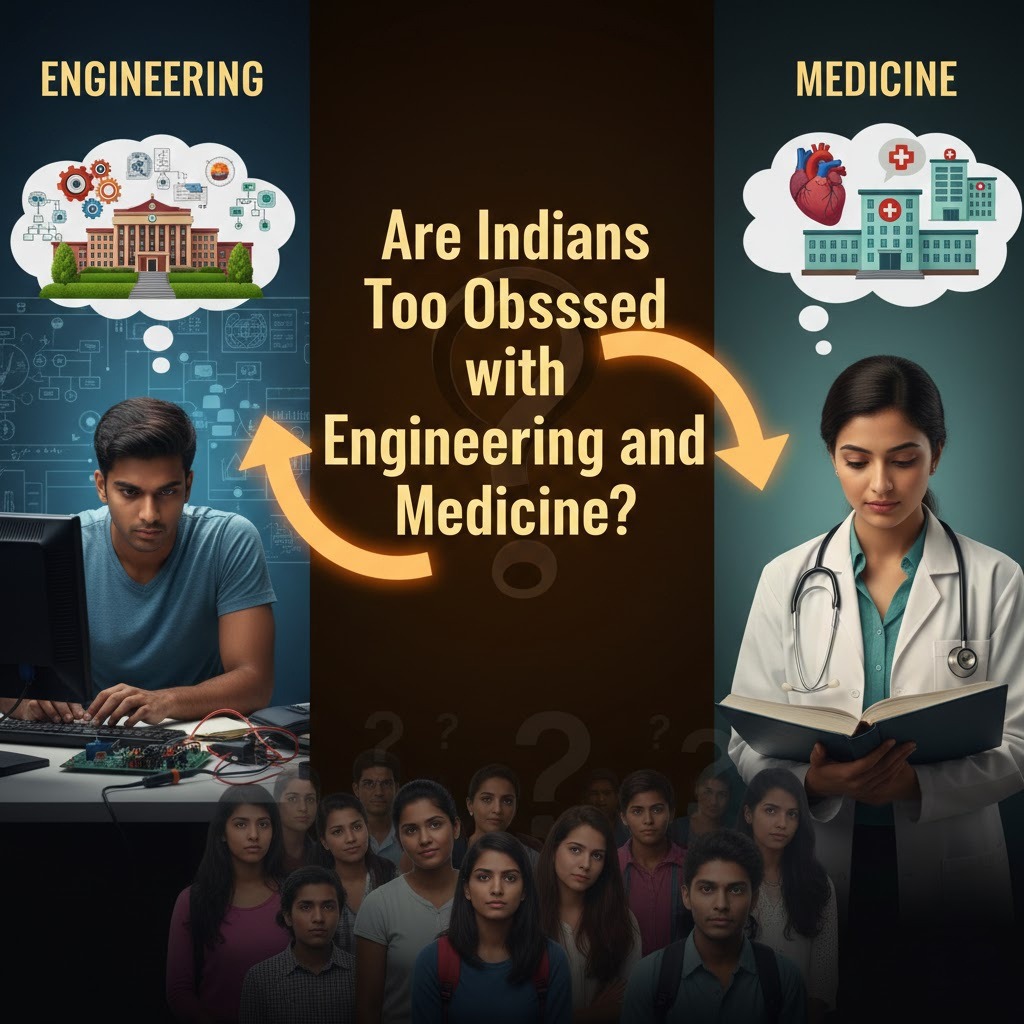
Walk into any middle-class household in India and ask a simple question:
“What do you want your child to become?”
The most common answers?
- Engineer
- Doctor
Rarely do you hear:
Artist. Historian. Chef. Entrepreneur. Psychologist. Policy expert.
So it’s fair to ask — Are Indians too obsessed with engineering and medicine?
This question isn’t about disrespecting these professions. Engineers and doctors are vital to any society. The real debate is about balance, pressure, identity, and choice.
In this opinion piece, let’s unpack whether “Are Indians too obsessed with engineering and medicine?” is a stereotype—or a social reality.
The Cultural Backdrop
To understand if Indians are too obsessed with engineering and medicine, we need to go back a few decades.
For many Indian families:
- Stability was survival
- Government jobs were gold
- Predictable income meant security
- Professional degrees meant status
Engineering and medicine represented:
- Respect
- Financial stability
- Marriage prospects
- Social mobility
For parents who grew up without safety nets, pushing children toward these careers wasn’t obsession.
It was protection.
The Prestige Pyramid
Let’s be honest.
In many communities, professions are ranked.
At the top:
- Doctors
- Engineers
Then comes:
- Chartered accountants
- Civil servants
- Corporate professionals
Creative careers often sit lower on this social pyramid.
This ranking influences not just career decisions but even arranged marriage conversations. “Engineer ladka” or “Doctor ladki” still carries a distinct social premium.
So when asking Are Indians too obsessed with engineering and medicine, we must acknowledge how deeply status is woven into professional identity.
The Coaching Culture
India’s exam ecosystem reinforces the debate around Are Indians too obsessed with engineering and medicine.
Consider:
- JEE preparation starting in Class 8
- NEET coaching is becoming a multi-billion-dollar industry.
- Students relocating cities for test prep
- Two-year “drop years” becoming normalized
This intensity isn’t accidental.
It reflects a national narrative: cracking engineering or medical entrance exams equals success.
But at what cost?
The Pressure Cooker Effect
Let’s talk about the emotional side.
When children grow up hearing:
- “Beta, engineering kar lo, life set ho jayegi.”
- “Doctor ban jao, respect milegi.”
Choice shrinks.
Passion becomes secondary.
Failure becomes catastrophic.
We should teach young Indians how to handle failure in a healthy way. If your entire identity revolves around becoming an engineer or doctor, failing to secure that position can lead to a sense of personal collapse.
This is where Are Indians too obsessed with engineering and medicine becomes a mental health question.
Is It Really Obsession—Or Economic Logic?
Before we criticize, let’s consider reality.
India has:
- High population
- Limited job security
- Weak social safety nets
- Inconsistent labor protections
For many families, engineering and medicine offer:
- Clear career pathways
- Structured progression
- High earning potential
- Possibility of financial independence at 40
In a country without universal welfare systems, professional stability becomes insurance.
So maybe the question isn’t just Are Indians too obsessed with engineering and medicine.
Maybe it’s: Are Indians afraid of instability?
The Changing Landscape
The job market in 2025 is not the job market of 1995.
Today we see:
- Content creators earning crores
- Startups redefining industries
- Policy analysts shaping governance
- Designers building global brands
- Data scientists without traditional engineering degrees
The rise of remote work, digital platforms, and conversations about a four-day work week in India suggest that professional success is diversifying.
Yet parental expectations often lag behind market evolution.
This disconnect fuels the debate around Are Indians too obsessed with engineering and medicine.
The Social Cost of Narrow Definitions of Success
When success is narrowly defined, consequences follow.
1. Talent Misallocation
A brilliant storyteller forced into engineering becomes an average engineer and a frustrated human.
A naturally empathetic person pushed toward medicine may struggle with burnout.
Society loses diversity of excellence.
2. Overcrowded Professions
India produces lakhs of engineers annually.
Yet employability remains a concern.
Not all engineering graduates secure relevant roles.
Our evidence suggests that the problem isn’t ambition—it’s oversupply.
Is Indian obsession with engineering and medical becoming as much an economic issue as a cultural one?
3. Delayed Self-Discovery
Many professionals pivot at 30.
Some quit corporate roles to pursue:
- Writing
- Entrepreneurship
- Public policy
- Sustainable farming
But these shifts often happen after years of dissatisfaction.
Would earlier freedom have led to better alignment?
Marriage, Money, and Social Approval
Career choice in India doesn’t exist in isolation.
It connects to:
- Marriage prospects
- Family reputation
- Financial expectations
In some families, career prestige influences arranged marriage negotiations. Income stability is discussed openly.
Similarly, the dream of financial independence at 40 often guides career selection.
When viewed through this lens, Are Indians too obsessed with engineering and medicine reflects societal incentives—not just parental stubbornness.
A Counter-Argument: Excellence Requires Focus
There’s another side.
Countries that dominate globally often focus intensely on specific fields.
India’s IT boom emerged because thousands pursued engineering.
Our healthcare infrastructure depends heavily on trained medical professionals.
Perhaps Are Indians too obsessed with engineering and medicine overlooks the collective benefits of concentrated ambition.
The problem may not be obsession but a lack of parallel encouragement for other fields.
Expanding the Definition of Respect
Respect shouldn’t be profession-specific.
Imagine a society where we equally celebrate:
- Teachers
- Psychologists
- Researchers
- Social workers
- Public servants advocating mandatory voting reforms
- Entrepreneurs building sustainable businesses
When we broaden what we respect, career pressure reduces.
And the intensity behind Are Indians too obsessed with engineering and medicine softens.
What Needs to Change?
If we want balance, not rebellion, here’s what can shift:
1. Normalize Career Exploration
Gap years. Internships. Experimentation.
Career certainty at 17 is unrealistic.
2. Teach Handling Failure
Failure must be considered redirection, not disgrace.
Schools rarely teach resilience.
But handling failure is essential in any profession—engineering included.
3. Update Parental Narratives
Parents need exposure to evolving industries.
Workshops, career counseling, and real market data can help families make informed decisions.
4. Economic Reform
Broader job security across industries reduces fear-based career choices.
When creative careers offer stable income, the obsession debate fades.
So, Are Indians Too Obsessed with Engineering and Medicine?
Here’s the nuanced answer:
Yes—in many social circles, there is disproportionate emphasis.
But that emphasis comes from:
- Historical insecurity
- Economic uncertainty
- Social validation systems
- Limited awareness of alternative paths
The obsession is not rooted in ignorance.
It is rooted in survival instincts.
The future question shouldn’t just be, “Are Indians too obsessed with engineering and medicine?”
It should be: How do we create a society where multiple career paths feel equally safe and respectable?
Final Thoughts
Engineering and medicine are honorable professions.
The problem begins when they become default choices rather than deliberate ones.
When children choose freely, supported rather than pressured, excellence follows naturally.
If India wants innovation across sectors—from governance to arts to technology—it must redefine success beyond two professions.
Until then, the debate around Are Indians too obsessed with engineering and medicine will continue.
And maybe that debate itself is a sign of progress.
FAQs
- Does arranged marriage influence career choices?
In some cases, profession affects social status and marriage prospects. - Is financial independence at 40 driving career pressure?
Yes, predictable income paths influence long-term planning. - Are creative careers less respected in India?
They often lack the same social prestige as traditional professions. - Has the four-day workweek in India changed career thinking?
It signals an evolving work culture beyond traditional professions. - Do all Indian families push engineering and medicine?
No, but the cultural pattern remains strong in many regions. - Could mandatory voting change career priorities?
Greater civic engagement may diversify aspirations over time. - Is this obsession decreasing among younger generations?
Yes, exposure to digital careers and global markets is shifting mindsets.